
Turn incoming LC SWIFTs into checked, actionable advice
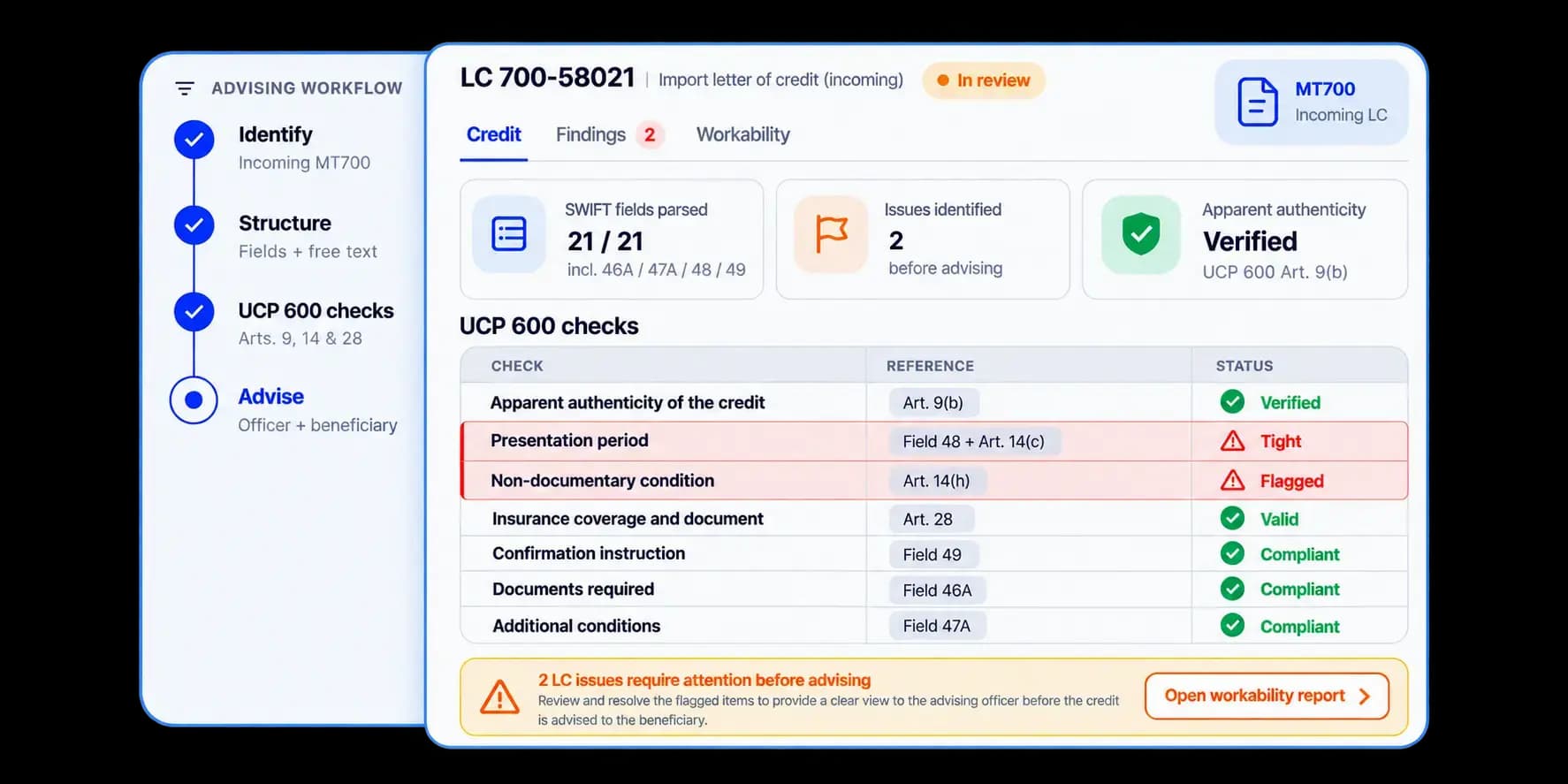
ArgusTrade identifies the incoming LC message, structures the complete credit, checks it against UCP 600, and gives the advising officer and beneficiary a clear view of the issues — before shipment begins.
Export LC advising requires more than forwarding a SWIFT message
Messages arrive in many forms
An incoming credit can be a new MT700, an MT707 amendment, an MT710/711 second advice, or a message split across MT701 continuation pages — treating them all the same is how a desk loses track of a credit's history.
Establishing the operative credit is manual
Officers have to connect amendments, continuation pages, and second advices to the correct case by hand, and work out which version of the credit is actually current.
SWIFT interpretation is manual
Coded fields and dense free-text blocks such as 46A and 47A are read line by line, every time a question comes up later in the transaction.
Authenticity and workability are checked by hand
Verifying apparent authenticity, identifying UCP 600 issues, and judging whether the terms are workable for the beneficiary all depend on experienced officers and scarce time.
From incoming SWIFT to beneficiary advice
Classification, extraction, and UCP 600 checking run as one pass on every incoming message, in that order — so the advice goes out against the correct, complete, current version of the credit.
Incoming SWIFT
- Operative credit linkedOK
- 46A / 47A parsedOK
- Presentation periodFlag
- Non-documentary cond.Flag
- Confirmation routingOK
Advice prepared
Identify the complete operative credit
Recognize MT700, MT707, and MT710/711 messages and connect them to the correct LC case. MT701 continuation pages are reassembled with the original message, and amendments are linked to the existing credit, so officers work from the complete, current version — whether this is the first message on the case or the fifth.
Extract and structure the LC terms
Capture the key credit terms across the SWIFT message: parties, amount, expiry, availability, shipment terms, goods, required documents, additional conditions, presentation period, confirmation instructions, and charges. Free-text fields such as 46A and 47A are broken into individual requirements, amendments are captured as changes against the operative credit, and ambiguous or non-standard data is surfaced for officer verification.
Run UCP 600 and workability checks
Review the credit for the advising bank's obligations under UCP 600 and for terms that could create problems for the beneficiary. Each finding is linked to the relevant rule for officer review — while there is still time to request an amendment.
Prepare the advice and workability report
Turn the reviewed credit into two clear outputs. The advising officer receives the technical findings with supporting rule references; the beneficiary receives a plain-language workability view of the credit, including terms or conditions that may need clarification or amendment before shipment.
The UCP 600 and workability checks
Apparent authenticity
SWIFT authentication is verified and the message set is checked for completeness — all continuation pages present, no truncation. If authenticity cannot be confirmed, the art. 9(f) path is flagged. (art. 9)
Presentation and expiry
The presentation period is weighed against the size of the 46A document set, and the expiry place and route are checked — so a tight window, or an expiry at the issuing bank's overseas counters, is flagged as a real risk rather than a technical pass. (arts. 6 & 14(c))
Conditions and shipment terms
Non-documentary conditions buried in field 47A are flagged, along with conflicts between a partial-shipment prohibition and an instalment drawdown schedule that carries its own strict timing under art. 32. (arts. 14(h), 31–32)
Insurance vs Incoterm
For CIF or CIP shipments, the engine confirms an insurance document is required in 46A and checks the coverage against UCP 600's 110% default where the credit does not specify otherwise. (art. 28)
Confirmation instructions
A “confirm” instruction in field 49 is checked against the issuing bank, country, and tenor profile and routed to your confirmation desk where your bank's risk process calls for review. (field 49)
Amendment impact
When an MT707 extends a shipment date, the engine checks that expiry and presentation period were adjusted to match — catching the “extension” that quietly leaves the beneficiary no more time to present than before. (MT707)
Improve how the bank handles export LC advising
Review the right version of the credit
Keep new messages, continuation pages, amendments, and second advices connected to the correct case and operative LC.
Reduce manual SWIFT interpretation
Structure coded and free-text fields so officers do not have to repeatedly work through dense message text.
Identify issues before shipment
Surface UCP 600 issues and practical workability risks while the beneficiary still has time to seek an amendment.
Give beneficiaries clearer advice
Translate technical findings into a workability view that helps beneficiaries understand what requires attention before they act on the credit.
Move from incoming SWIFT to actionable advice
See how ArgusTrade can identify the operative credit, structure the LC terms, run UCP 600 and workability checks, and prepare the advice for your officer and beneficiary. Forward us a real incoming MT700 and we'll show you what it classifies as, what it extracts from the free-text fields, and every finding it triggers — before the advice goes out.