
Turn LC applications into checked, issuance-ready drafts
ArgusTrade reads the LC application and supporting documents, extracts and reconciles the required information, checks the request against UCP 600, and prepares the reviewed data for LC drafting and MT700 generation — all in one issuance workflow.
Import LC issuance still requires too much manual review
Applications arrive in every format
Banks receive their own application forms, corporate free-format requests, scanned and handwritten documents, portal submissions, and emails with contracts, invoices, and purchase orders attached — sometimes with a prior LC copy for an amendment-style request.
Every submission is read by hand
Trade teams identify what has been submitted and re-key the LC terms from each document, increasing the likelihood of validation errors and incomplete applications.
Cross-checking is manual
Information has to be compared across the application, the pro forma invoice, and the underlying contract to catch missing or inconsistent data — work that is slow and easy to miss under pressure.
Checks and prep come last
UCP 600 checks and the preparation of issuance data are applied late in the process, so problems surface after drafting as costly amendments rather than before a single field is committed.
From application to issuance-ready LC
Classification, extraction, and UCP 600 checking run as one continuous pass on every application, in that order, regardless of how it arrived.
LC application
- Parties & amountOK
- Date logic (art. 14c)OK
- Non-documentary cond.Flag
- Insurance vs IncotermFlag
- MT700 fieldsOK
Prepared for issuance
Understand the complete request
Identify the LC application and classify its supporting documents — purchase orders, pro forma invoices, contracts, facility letters, and prior LC copies where submitted. ArgusTrade handles bank forms, corporate formats, scanned applications, portal submissions, and email-led requests, and flags missing attachments or unclear pages before the case moves forward.
Extract and reconcile LC data
Capture the information required for issuance: parties, amount and currency, tenor and expiry, shipment and presentation terms, ports, Incoterms, goods, tolerances, document requirements, and special conditions. Typed fields, handwritten entries, tables, and annexures are read in the same workflow, compared across documents, with inconsistencies and low-confidence fields surfaced for officer verification rather than passed through automatically.
Run UCP 600 checks before drafting
Review the structured request against the relevant UCP 600 requirements before the credit is issued. Each finding is linked to the applicable article and classified as blocking, waivable, or advisory for officer review — so a problem is caught while it still costs nothing to fix.
Prepare and validate the MT700
Use the reviewed case record to drive LC drafting and populate the required SWIFT data without re-entering information from the original application. ArgusTrade validates mandatory MT700 fields for completeness, permitted character sets, and cross-field consistency before the message reaches the checker.
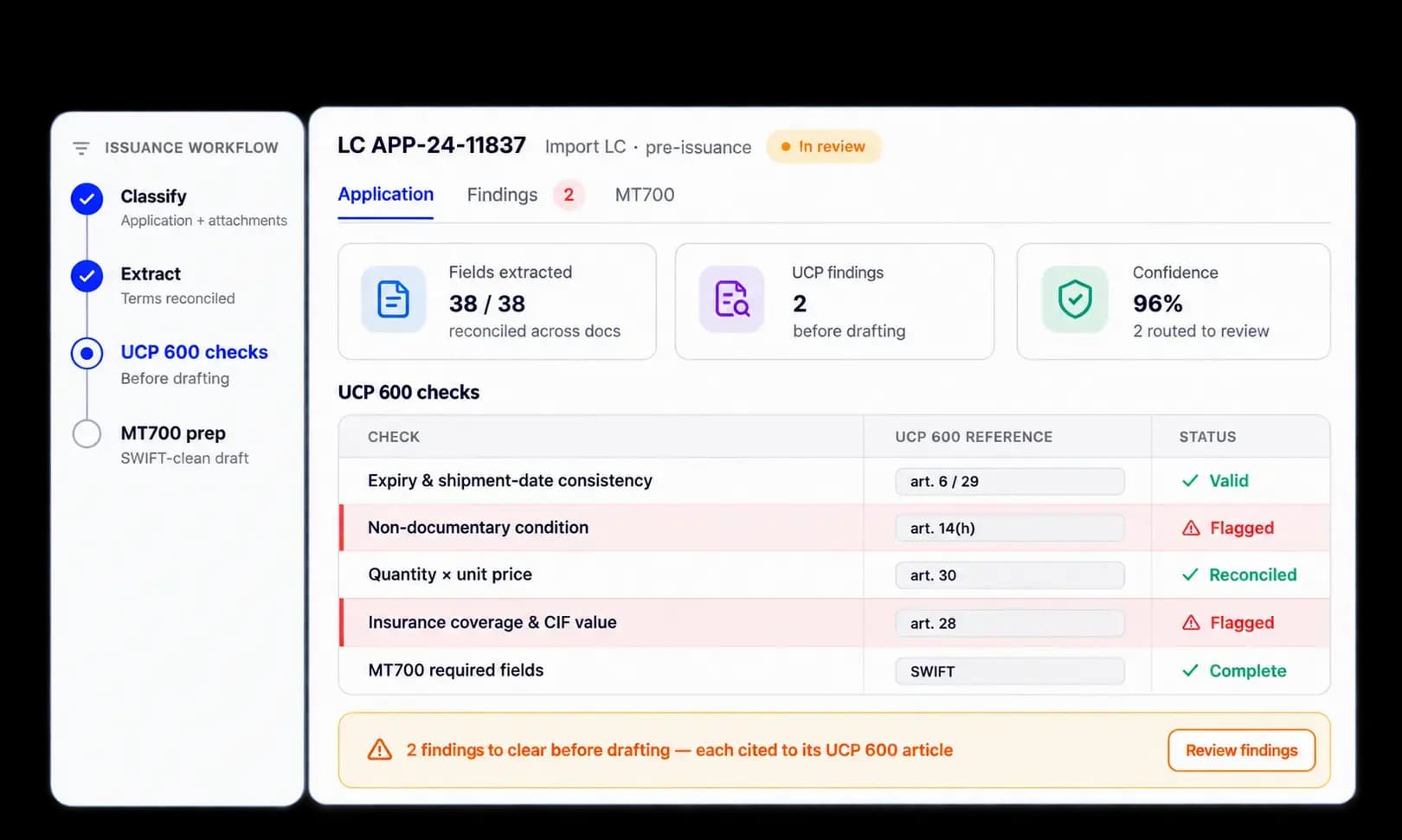
The UCP 600 checks, run before drafting
Date logic
Expiry, latest shipment date, and presentation period are checked against each other. If a shipment date is stated with no presentation period, the UCP 600 default of 21 days is applied and flagged — with a warning when it leaves too little time before expiry. (art. 6 & 14(c))
Non-documentary conditions
A condition such as “goods must be of satisfactory quality” with no document named to evidence it is flagged, so it can be converted into a documentary requirement at drafting rather than disregarded later. (art. 14(h))
Amount and tolerance
Qualifiers like “about” or “approximately” apply the 10% tolerance automatically. Where they are absent, the engine checks that quantity × unit price reconciles to the stated amount. (art. 30)
Partial shipment & instalments
If partial shipment is prohibited but the application also describes multiple shipment dates or an instalment drawdown schedule, the contradiction is flagged — instalment shipments carry their own strict timing rules under art. 32. (arts. 31–32)
Insurance vs Incoterm
For CIF or CIP shipments, the engine confirms an insurance document is required and checks the requested coverage against UCP 600's default minimum of 110% of the CIF/CIP value unless the application states otherwise. (art. 28)
Document workability
A required document no agency in the beneficiary's country issues, or a certification with no named issuer, is flagged as a workability risk — before it becomes a discrepancy the beneficiary cannot cure. (document set)
Improve how the bank handles LC issuance
Reduce manual document review
Read and reconcile the application and supporting documents within the same issuance workflow.
Catch issues before issuance
Surface missing information, inconsistent terms, UCP 600 exceptions, and document workability issues before the credit is issued.
Reduce repeated data entry
Use the reviewed case record to drive the LC draft and MT700 data instead of entering the same information again downstream.
Keep officers in control
Route uncertain information and identified exceptions for review, with the relevant source data and rule available for verification.
Move from application to issuance-ready LC
See how ArgusTrade can classify the request, reconcile the supporting documents, run UCP 600 checks, and prepare the data required for issuance. Send us a real LC application and we'll show you what it classifies as, what it extracts, and every UCP 600 check it triggers — before a draft is even issued.