
Trade-Based Money Laundering Detection, Built into the Trade Workflow
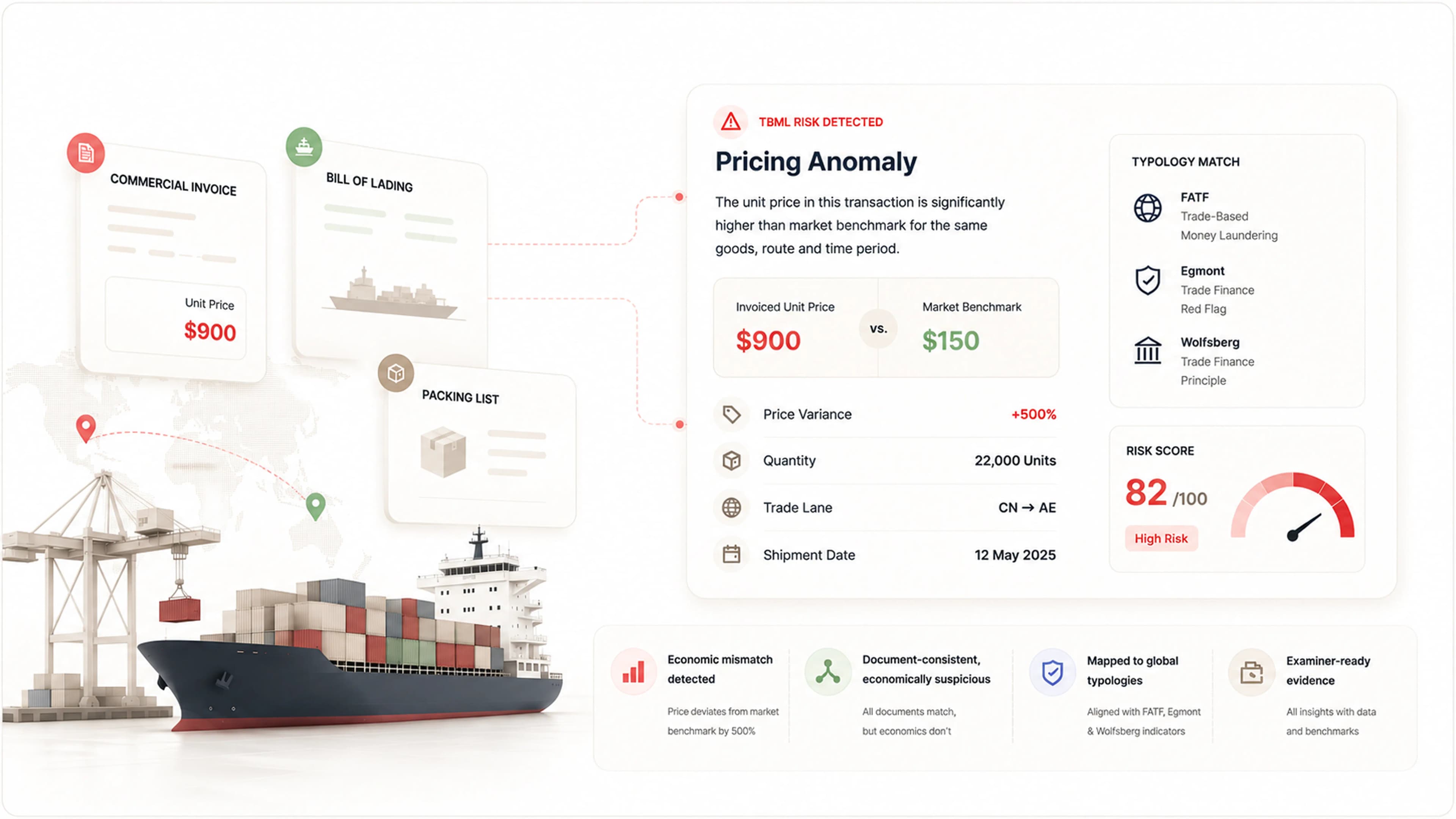
ArgusTrade analyzes pricing, quantities, routing, counterparties, and trade documents to identify trade-based money laundering (TBML) risks. Every anomaly is evaluated against market baselines, explained with supporting evidence, and mapped to FATF, Egmont, and Wolfsberg typologies.
Why banks use ArgusTrade
Detect risk beyond payment data
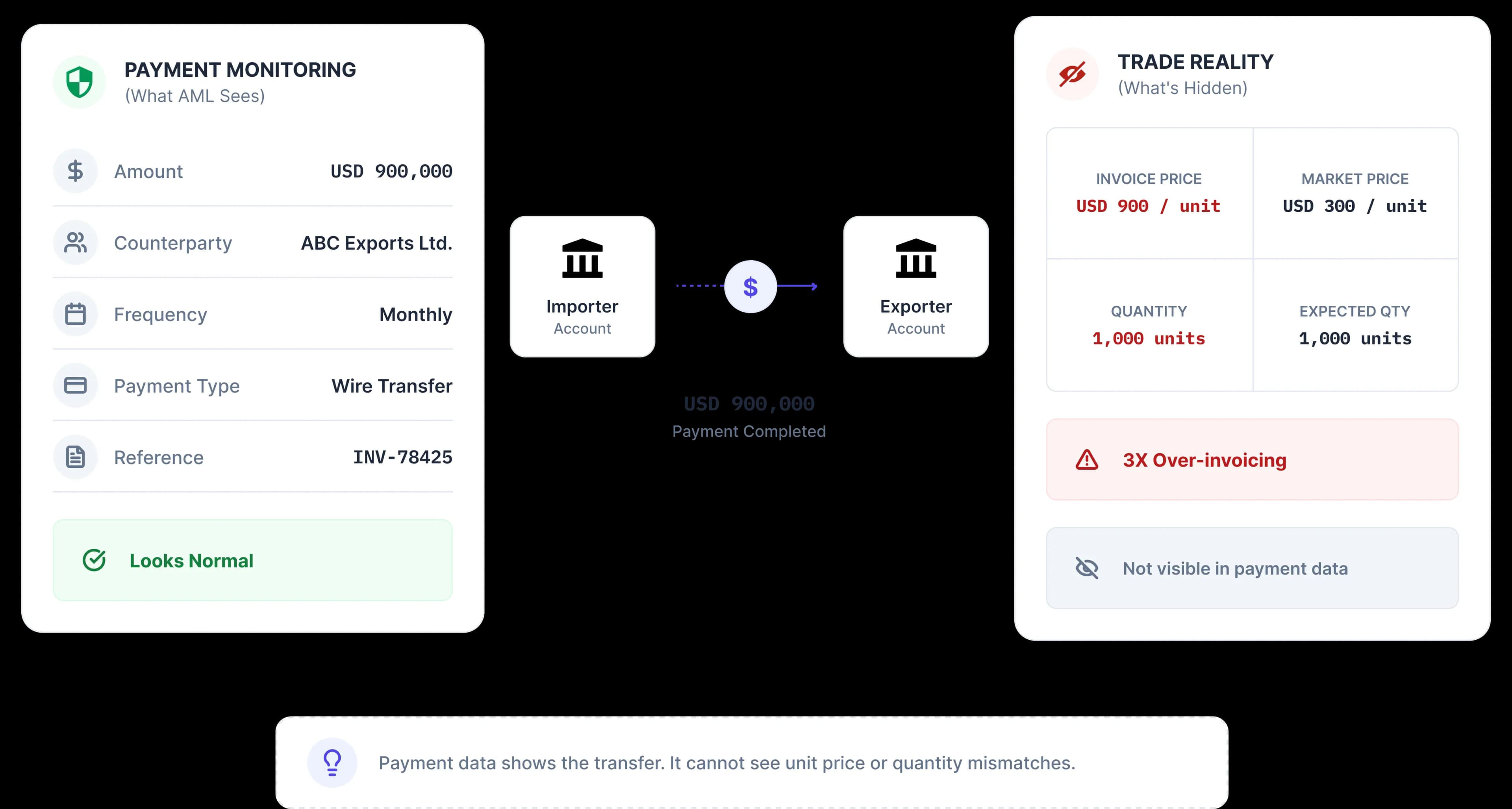
Traditional transaction monitoring analyzes payment activity. ArgusTrade evaluates the underlying trade transaction using invoices, bills of lading, quantities, pricing, routing, and counterparties to identify TBML risks that payment data alone cannot detect.
Context-aware anomaly detection
Every transaction is evaluated against multiple reference points, including the customer's historical activity, corridor-level trade patterns, and market pricing. Legitimate commercial variation is separated from economically suspicious transactions.
Typology-based investigations
Every alert is mapped to recognized FATF, Egmont, and Wolfsberg typologies with supporting evidence, giving investigators a structured starting point for review.
One trade data model
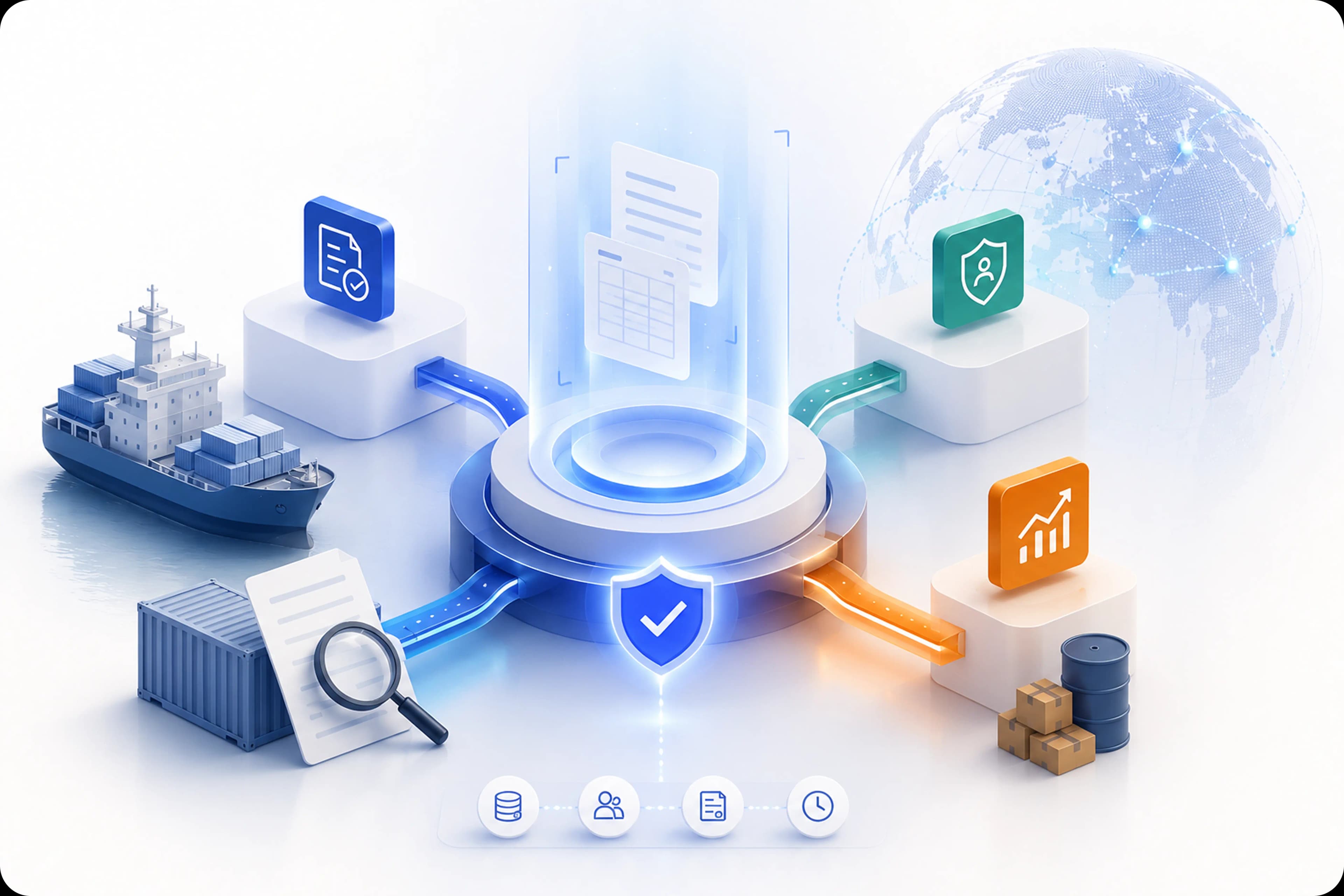
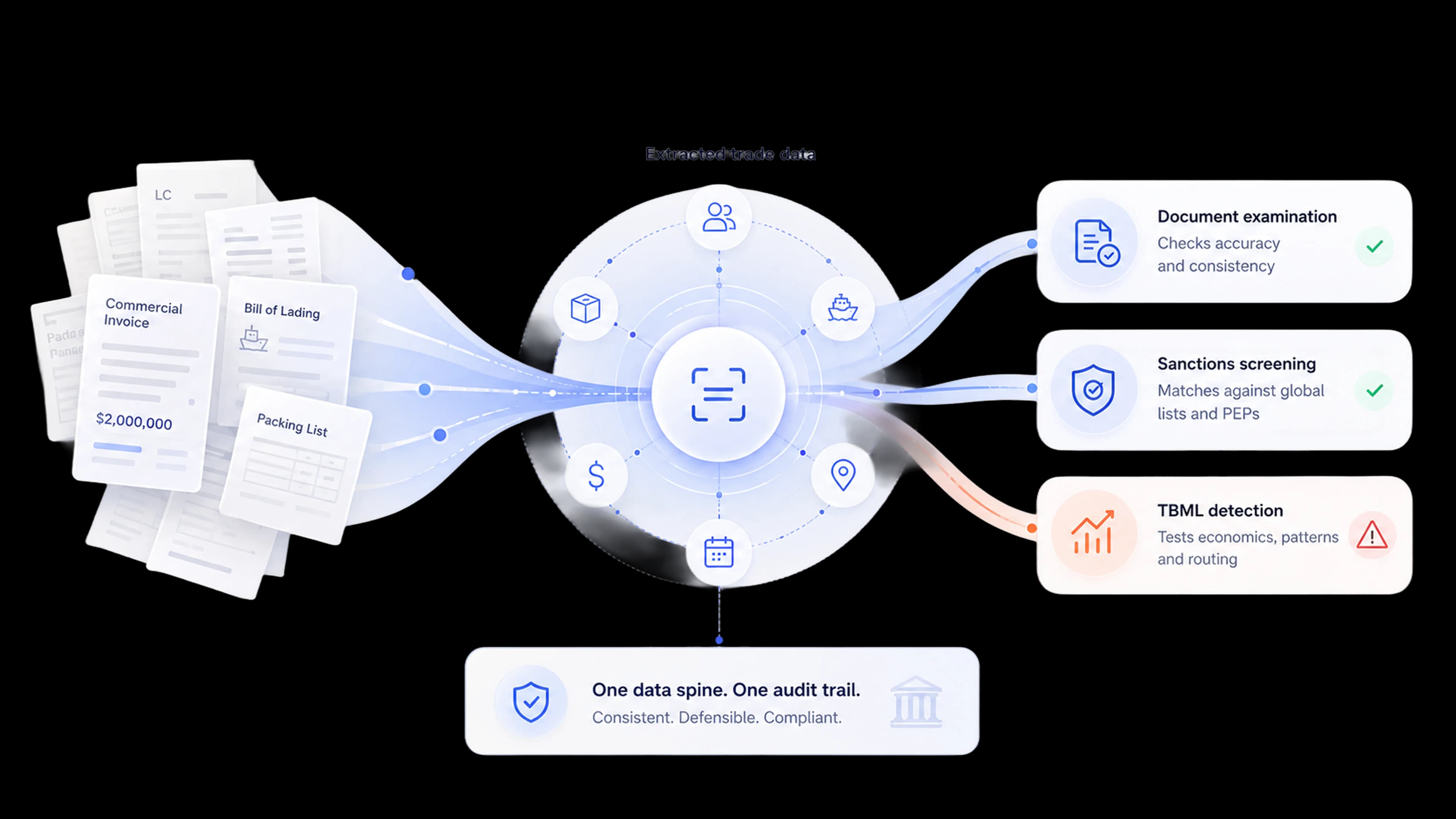
Document examination, sanctions screening, and TBML detection all operate on the same extracted trade data, creating a consistent workflow and a complete audit trail.
Why traditional controls miss TBML risk
A transaction may satisfy documentary credit requirements while still exhibiting characteristics associated with trade-based money laundering. Document examination validates compliance with the Letter of Credit. It does not determine whether pricing, quantities, routing, or trading patterns are commercially reasonable.
Manual validation is difficult
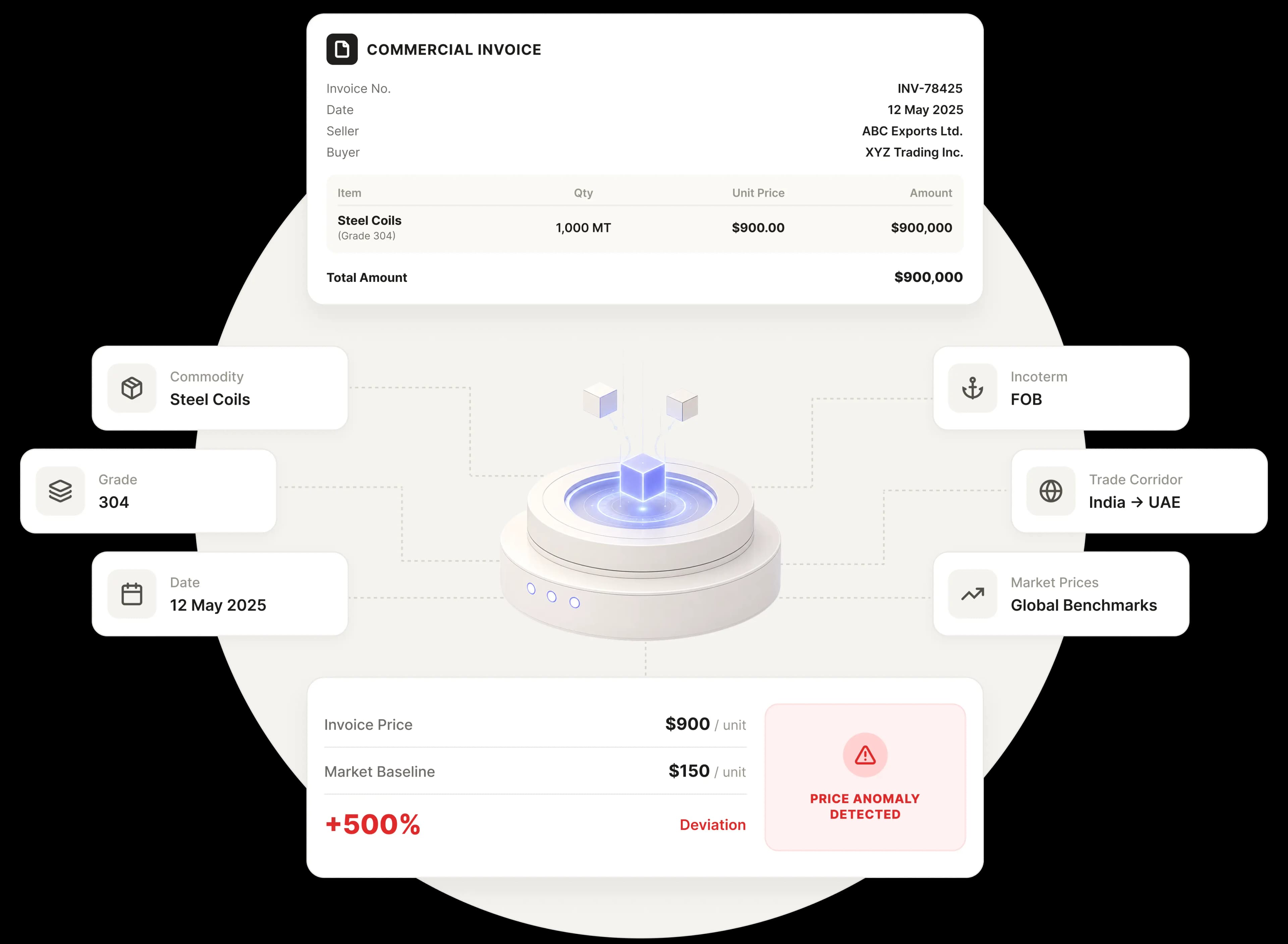
Verifying pricing requires knowledge of commodity values, grades, Incoterms, trade corridors, and shipment dates. Performing that analysis manually across every transaction is not practical.
Payment monitoring has limited visibility
Payment monitoring identifies unusual financial activity but cannot evaluate unit prices, quantities, goods descriptions, or commercial relationships contained within trade documents.
Portfolio-level risk
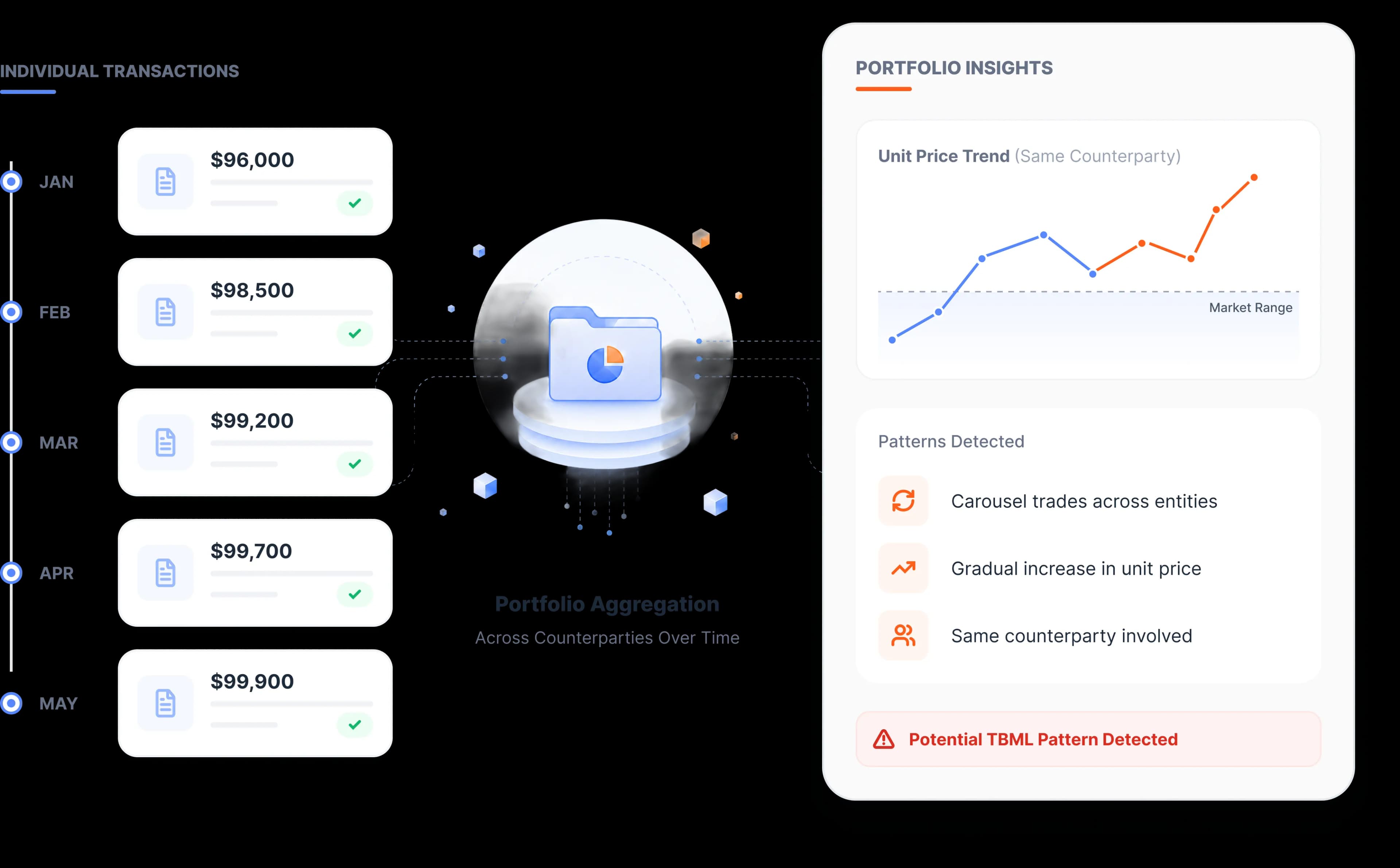
Patterns such as carousel trading, repeated mispricing, and coordinated counterparty behavior often emerge only when transactions are analyzed across the portfolio.
Trade routing anomalies
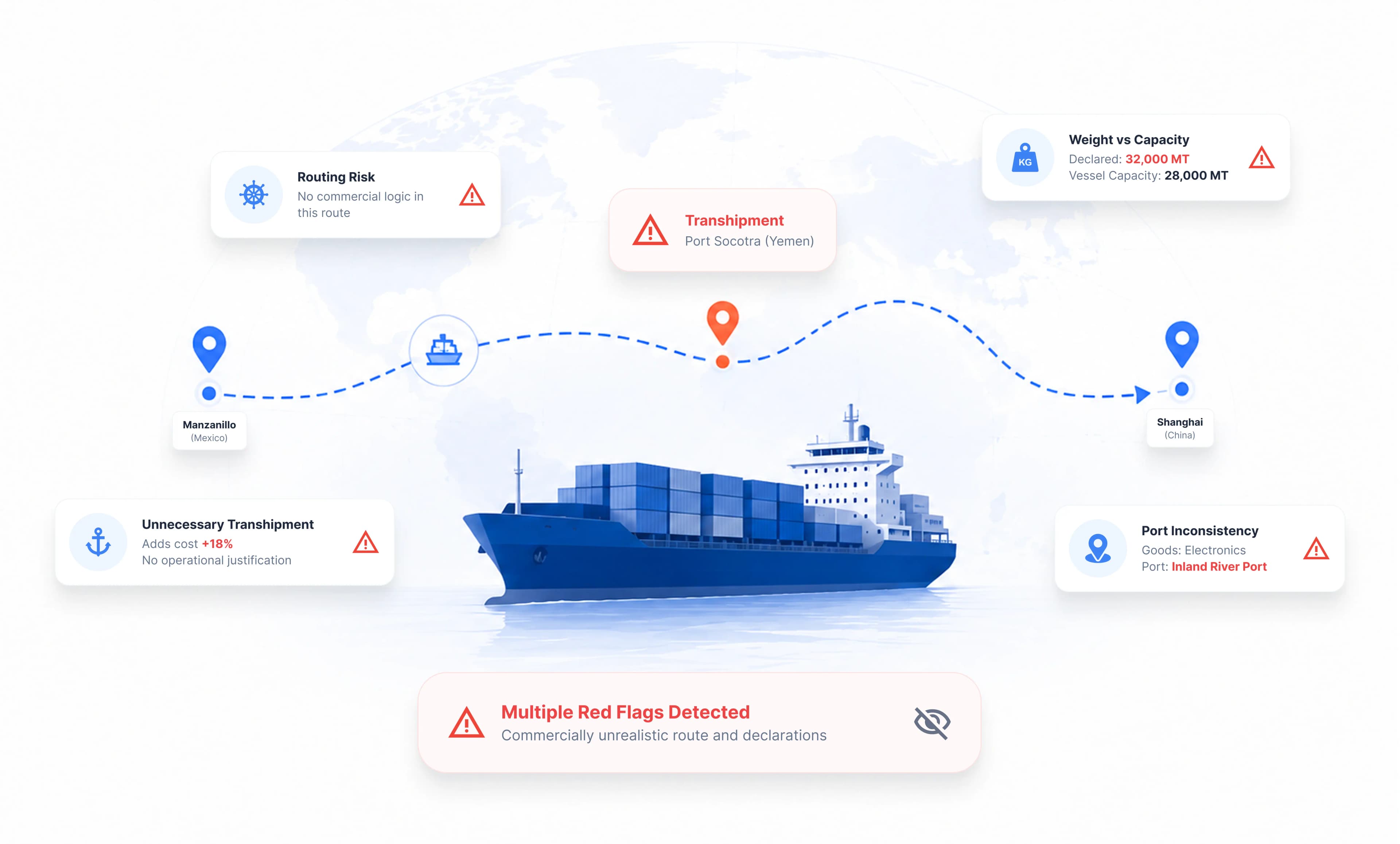
Unusual routing, unnecessary transshipment, vessel inconsistencies, and logistics patterns can indicate elevated TBML risk despite compliant documentation.
Increasing regulatory expectations
Regulators increasingly expect financial institutions to demonstrate dedicated TBML controls aligned with recognized industry frameworks and typologies.
Turn TBML detection into a systematic control
Score every transaction
Evaluate every trade transaction during processing using structured TBML analytics rather than selective manual review.
Improve investigation efficiency
Provide investigators with pre-assembled evidence, pricing baselines, transaction history, and typology mapping before case review begins.
Reduce unnecessary alerts
Use layered pricing baselines, customer context, and configurable materiality thresholds to focus investigations on higher-risk activity.
Identify portfolio-wide patterns
Detect recurring pricing anomalies, counterparty relationships, and high-risk trade corridors across the trade portfolio.
Strengthen regulatory readiness
Support examinations with documented controls, typology mapping, and complete decision records for every investigation.
No additional operational workload
TBML analysis uses the same trade data already extracted during document examination without requiring additional manual data entry.
Proven results
How ArgusTrade detects TBML
Pricing and valuation analysis
Evaluate unit prices against customer history, trade corridor benchmarks, and market reference pricing while accounting for commodity grade, Incoterms, shipment dates, and declared quantities.
Quantity and shipment validation
Identify over-shipment, short-shipment, duplicate invoicing, inconsistent goods descriptions, and shipment anomalies by comparing invoices, transport documents, and supporting trade records.
Routing and counterparty analysis
Detect unusual routing, high-risk trade corridors, circular trade structures, counterparty relationships, and pricing trends across connected transactions.
Risk scoring and investigations
Generate transparent risk scores with supporting evidence, map alerts to FATF, Egmont, and Wolfsberg typologies, and route cases through configurable investigation workflows.
Program oversight
Maintain a complete record of every score, alert, investigation, and decision. Dashboards help MLROs monitor anomaly trends by customer, corridor, commodity, and goods category.
How it works
- Goods
- PVC resin, grade S65
- Unit price
- USD 3,720 / MT
- Quantity
- 500 MT
- Market ref
- USD 900 / MT
- Route
- Jebel Ali → Klaipeda
- Transhipment
- via Novorossiysk
- Vessel DWT
- 12,000 MT
- Declared
- 18,500 MT
Extract and establish baselines
ArgusTrade extracts pricing, quantities, parties, routing, vessels, and shipment information from trade documents. Each transaction is evaluated against customer history, corridor benchmarks, and market reference data.
Analyze and score
Transactions are tested against TBML typologies and portfolio-wide patterns. Individual signals contribute to a transparent risk score, with higher-risk cases automatically routed for investigation.
Investigate and decide
Investigators review supporting evidence, request additional information where required, approve legitimate activity, or escalate suspicious transactions through existing compliance workflows.
Monitor and report
Every investigation outcome contributes to ongoing portfolio analytics while maintaining a complete audit record of scores, evidence, reviewer actions, and final decisions.
See how ArgusTrade detects trade-based money laundering
Bring a real trade transaction. We'll show how ArgusTrade evaluates pricing, routing, counterparties, and trade documents to identify TBML risks with supporting evidence and complete auditability.