
When Yesterday's Price Meets Today's Trade
Team ArgusLoop
7 October 2026 · 4 Min
Introduction
In the theater of global trade, money launderers do not hide in the shadows; they hide in plain sight. Trade-Based Money Laundering (TBML) operates via bills of lading, letters of credit, and seemingly benign commercial invoices. The Financial Action Task Force (FATF) estimates that TBML accounts for up to $2 trillion in illicit flows globally each year. Furthermore, according to Global Financial Integrity (GFI), the trade value gap between developing nations and their trading partners topped a staggering $3.2 trillion in 2022 alone.
Financial Institutional Investors (FIIs), and trade finance desks, the regulatory pressure is compounding. Yet, the primary line of defense against this systemic risk—verifying the Fair Market Value (FMV) of goods to catch over and under-invoicing—remains trapped in the past.
As institutions look to secure their supply chains and appease regulators, the industry is shifting toward dynamic automation. At the forefront of this evolution is the implementation of the "Free Price Check", a frictionless, AI-driven utility that instantly validates pricing before costly manual compliance workflows are triggered.
The Unsustainable Cost of Static Compliance
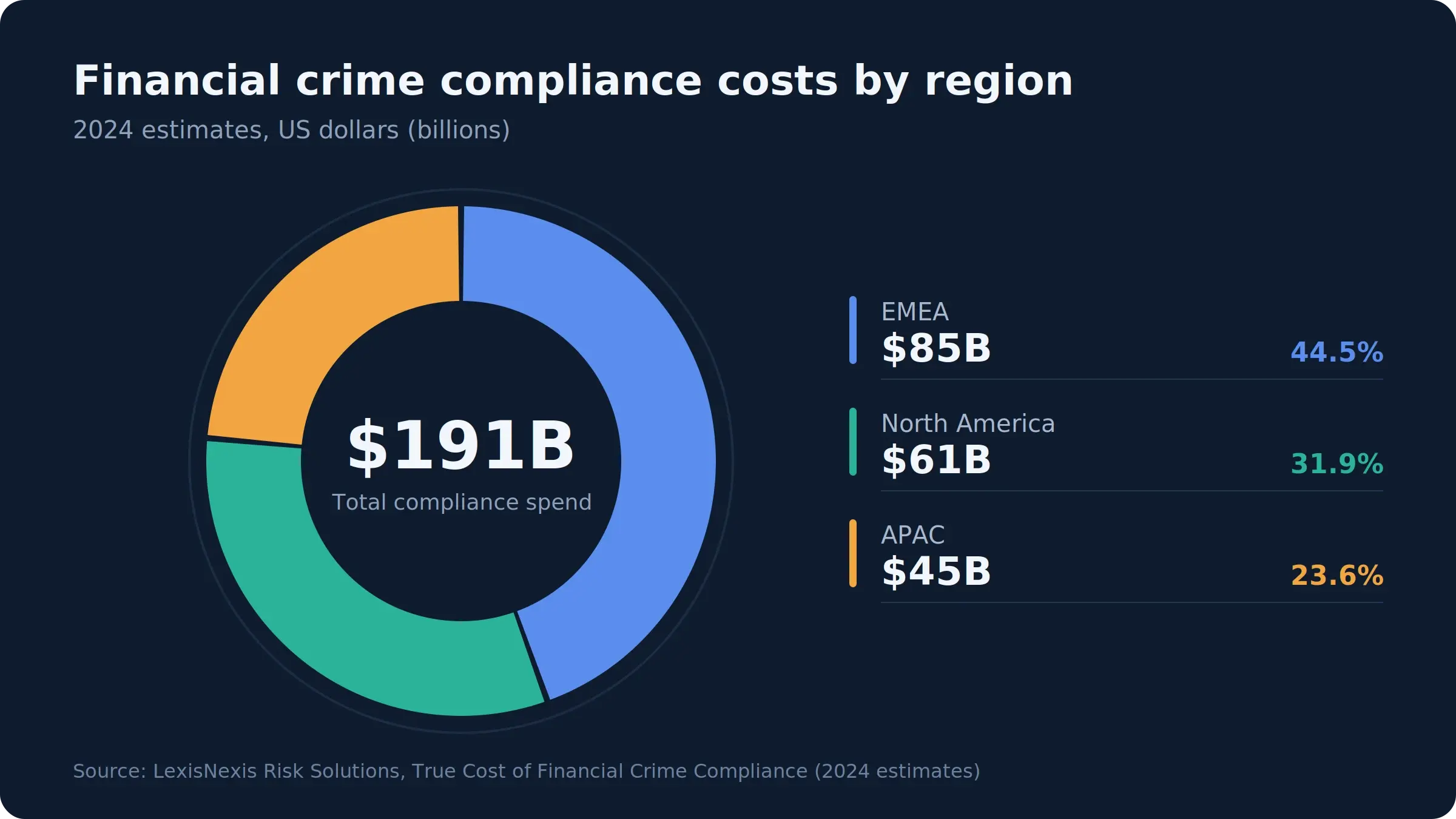
The true cost of financial crime compliance (FCC) is reaching critical mass. The 2024 Data from LexisNexis reveals that annual compliance costs have reached roughly $85 billion in EMEA, $61 billion in North America, and $45 billion in APAC.
Crucially, across all regions, 98% to 99% of financial institutions report rising costs, with over 70% attributing these hikes directly to manual labor, false positives, and inefficient legacy technology.
When a trade finance desk receives a documentary credit, such as a SWIFT MT700, compliance teams may need to verify declared invoice prices against available market and trade data. Because this process remains largely manual and data-intensive, each review can consume significant specialist capacity; when multiplied across high transaction volumes, the resulting FTE burden can materially increase the operational cost of trade finance.
The Ghost In The Supply Chain: Why Static Screening Fails
The traditional approach relies heavily on static screening: checking an invoice against historical customs data or quarterly commodity averages linked to 6-digit Harmonized System (HS) codes. But global trade is not static; it is violently dynamic.
Consider a TBML typology: The Copper Wire versus Scrap Copper discrepancy.
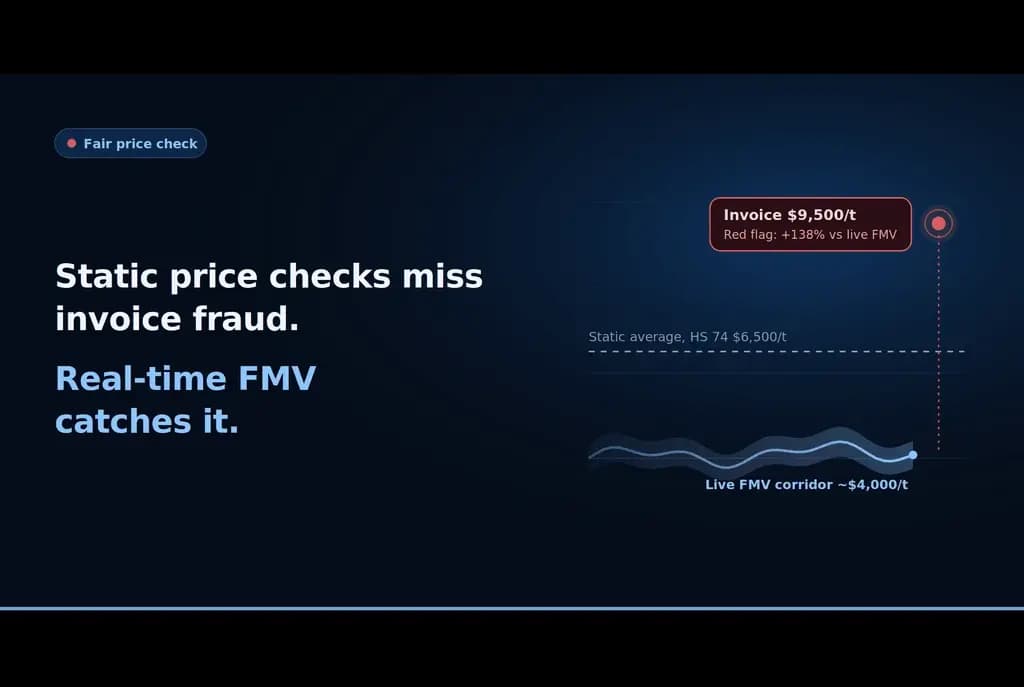
A bad actor exports a container of low-grade scrap copper but invoices it as high-purity electrical copper wire. If the current market price for scrap is $4,000 per metric ton and high-grade wire is $9,500, invoicing 100 tons of scrap as wire allows the launderer to move $550,000 of illicit funds across borders under the guise of legitimate commercial payment.
If a bank relies on a static database that averages "copper products" (HS Chapter 74) at $6,500/ton, the $9,500 invoice will likely trigger a red flag. However, a compliance officer might dismiss it as a premium regional variance, leading to a False Negative.
Conversely, if a legitimate supplier charges a justified premium for emergency air freight on specialized copper, the static system flags it as money laundering, creating a False Positive that requires hours of manual unpicking.
Static systems fail because:
- Real-time market volatility: They cannot account for sudden macro-economic shifts, such as freight super-cycles or sudden tariff impositions.
- Geospatial variances: A product inherently costs a different amount at different ports.
- Granularity: Standard 6-digit HS codes are too broad to capture product-specific nuances (e.g., the difference between a standard laptop and a military-grade ruggedized computer).
The Paradigm Shift Towards Dynamic Price Checks
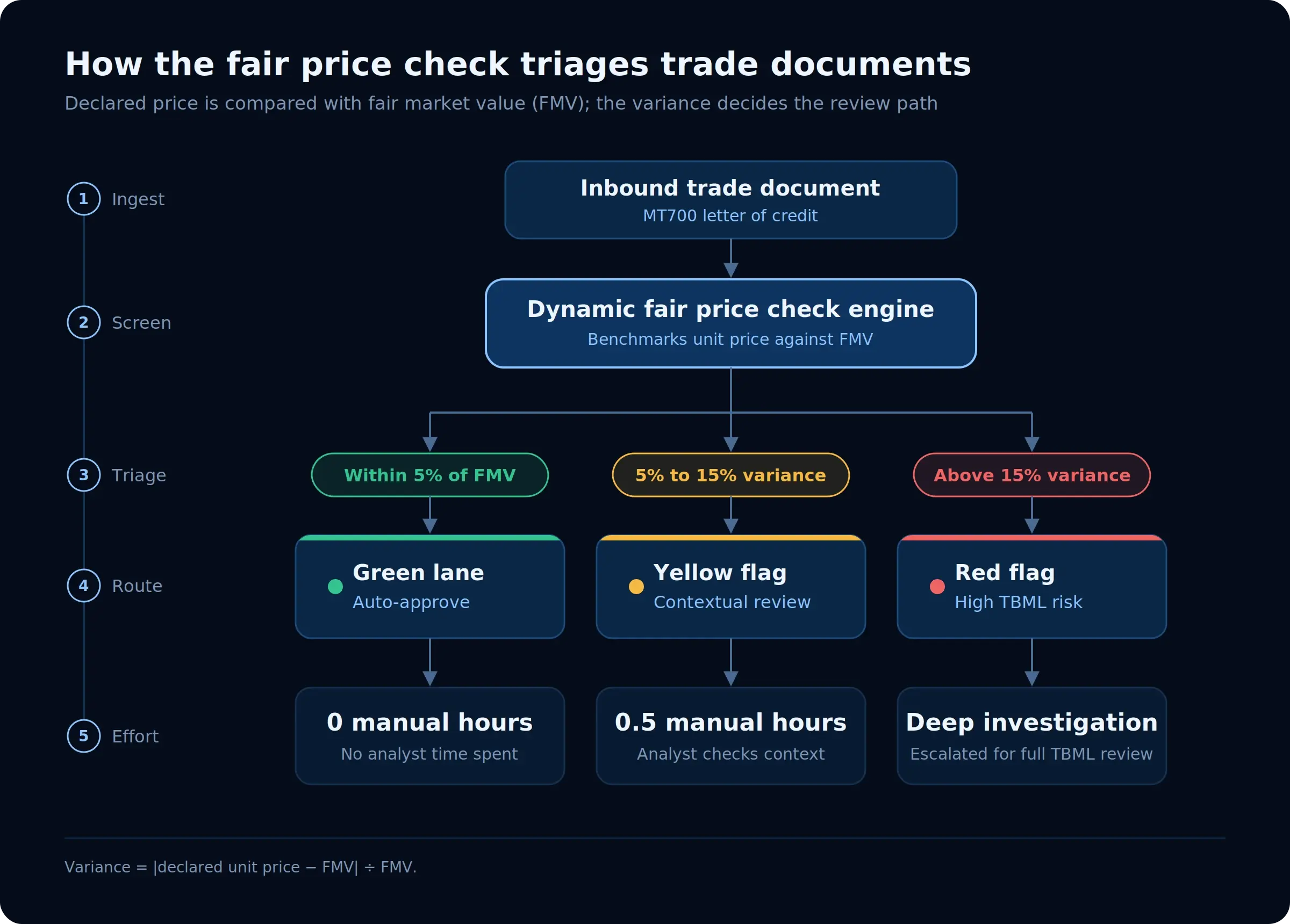
To combat this vulnerability, the industry is pivoting toward dynamic, AI-driven variance analysis. This transition is underpinned by the “Price Check” model, an operational framework embedded within advanced compliance architectures to restructure how initial screening is executed.
Rather than committing specialized compliance officers to manually investigate every inbound invoice, these model deploys an instant algorithmic query at the absolute top of the processing funnel.
The architecture programmatically ingests data from:
- Real-time B2B marketplaces
- Global shipping registries
- Live commodity indices
This generates a highly contextualized, real-time price band.
Consequently, Financial Institutions (FIs) and Banks can instantly verify whether an invoice price sits within a defensible Fair Market Value (FMV) corridor, achieving zero-friction initial validation without incurring upfront operational overhead.
The ROI of Dynamic Verification
When Institutions adopt automated, dynamic price verification, the data crunching yields immediate, measurable operational alpha:
1. Plummeting False Positives
Traditional transaction-monitoring systems can generate false-positive rates of 80–90% or more, creating substantial alert volumes, manual-review costs and compliance-team fatigue.
Dynamic price verification can strengthen TBML controls by testing invoice values against market conditions rather than relying solely on historical benchmarks.
2. Massive Labor Arbitrage
Automation can materially reduce the operational burden of price verification.
ICC notes that manual price checking remains the predominant approach, with staff assessing whether invoiced prices appear manifestly unusual and escalating cases for further review.
The process becomes particularly challenging when pricing depends on:
- Freight
- Insurance
- Product quality
- Geography
- Other commercial variables
At scale, this creates a meaningful opportunity for automation.
An illustrative scenario in which 1,000 monthly transactions each save 2.5 hours of manual review would release approximately 2,500 analyst hours per month, equivalent to roughly 15 FTEs.
The calculation is illustrative rather than an industry benchmark, but demonstrates the potential capacity that could be redirected from repetitive price validation toward higher-value investigation and risk analysis.
3. Regulatory Bulletproofing
Regulators are increasingly scrutinizing how banks determine FMV.
A static spreadsheet from six months ago no longer meets defensibility standards. Dynamic models provide an immutable, timestamped audit trail of market conditions at the exact moment of the transaction, ensuring audit-readiness.
Real-Life Implementation: The Timber Export Case
In May 2021 FATF case study regarding environmental crime and TBML, a timber export scheme was used to launder millions by under-invoicing raw teak wood.
Legacy compliance systems missed the anomaly because the stated invoice price matched a three-year-old historical average held in a static database.
A parallel financial investigation resulted in the identification and subsequent freezing of $10 million in criminal proceeds in complicit company accounts as well as the seizure of 80,000m³ of timber.
Had the facilitating FI utilized a dynamic price check at the point of entry, the system would have instantly pinged the current, real-time spot-market price of teak in the origin country, immediately flagging a 40% negative variance.
The illicit letter of credit issuance would have been frozen instantly, rather than discovered months later during a post-mortem audit.
Conclusion
The era of manual, static price screening in trade finance is officially over, crushed under the weight of its own inefficiency and the rapid sophistication of modern financial criminals.
As TBML continues to drain trillions from the global economy, banks and FIIs can no longer afford to throw human capital at a data problem.
The implementation of a "Free Price Check", an instant, AI-driven FMV verification at the gateway of every transaction, is not just a compliance upgrade; it is a strategic imperative.
For institutions looking to protect their margins, satisfy tightening regulatory frameworks, and shut the door on illicit flows, the path forward is absolute:
Automate the baseline, contextualize the data, and let the algorithms do the heavy lifting.
In the fight against the ghost in the supply chain, real-time data is the only light that works.
See it on your own transactions
Screening, examination, and decisioning with AI — inside your trade workflow, with the reasoning attached.