When Two Lcs Hide One trade: The Growing Risk Of Fragmented Screening
Satkrit Singh
28 September 2026 · 3 mins
Introduction
The relevance of back-to-back LCs becomes clearer when viewed against the scale of international trade.
Global trade reached $35 trillion in 2025, an increase of approximately $2.5 trillion, or 7.5%, in one year. Goods trade alone grew by roughly 7%, adding around $1.8 trillion. UN Trade and Development's latest data also puts global merchandise exports at $26.4 trillion in 2025.
At the same time, trade finance remains a constrained market. The Asian Development Bank's latest Global Trade Finance Gap Survey estimates the global trade-finance gap at $2.5 trillion in 2025, equivalent to approximately 10% of global trade. The survey incorporated responses from more than 110 trade-finance providers.
For compliance teams, the implication is not that back-to-back LCs are inherently risky. It is that more complex trade structures are operating inside an increasingly fragmented global trading environment.
When The LC Structure Becomes A Sanctions Problem
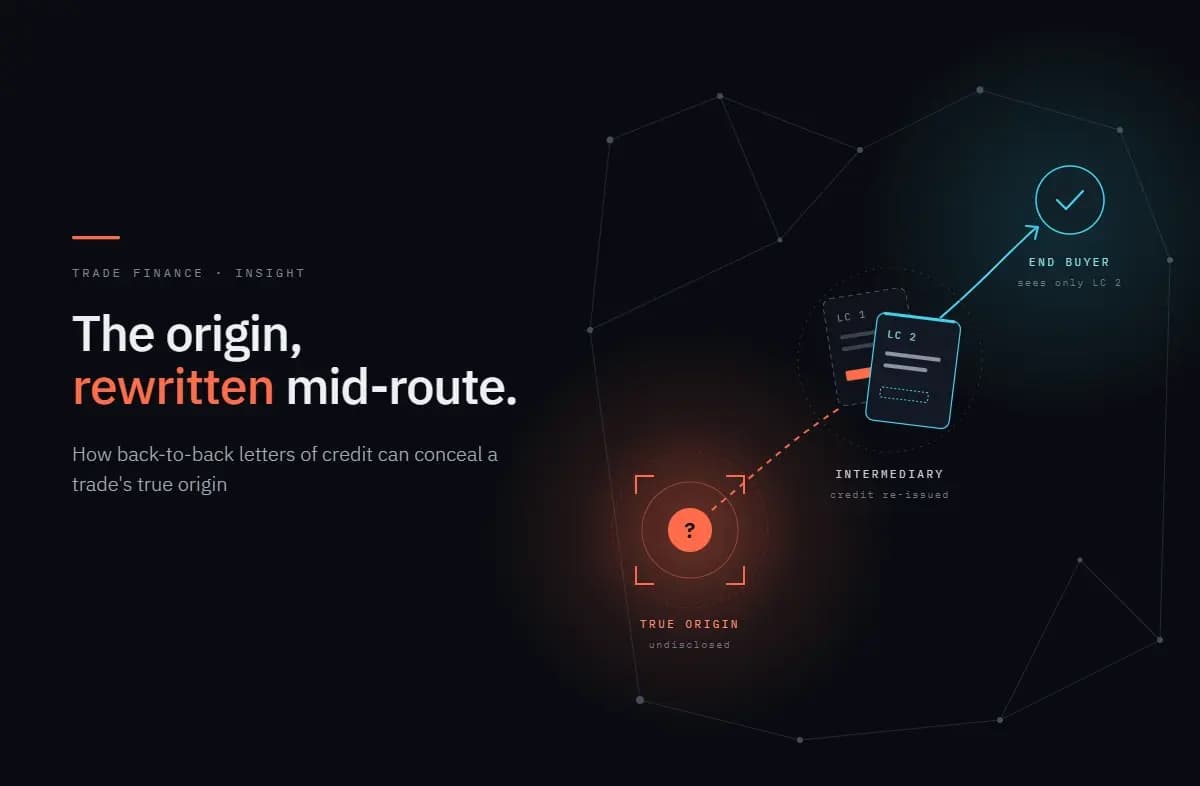
An oil producer in Country A, subject to sanctions, sells 200,000 barrels of crude to a broker in Country B. The broker routes the commodity through Country B and subsequently sells it to a buyer in Country C.
The first LC links the broker to the sanctioned-origin supplier.
The second LC links the broker to the final buyer.
If the second LC identifies Country B as the origin, the buyer and its bank may never see the original connection to Country A.
This is not merely a documentation issue. It demonstrates why screening only the parties appearing on the immediate LC can produce an incomplete risk picture.
A recent case shows why the intermediary cannot be treated as a blind spot
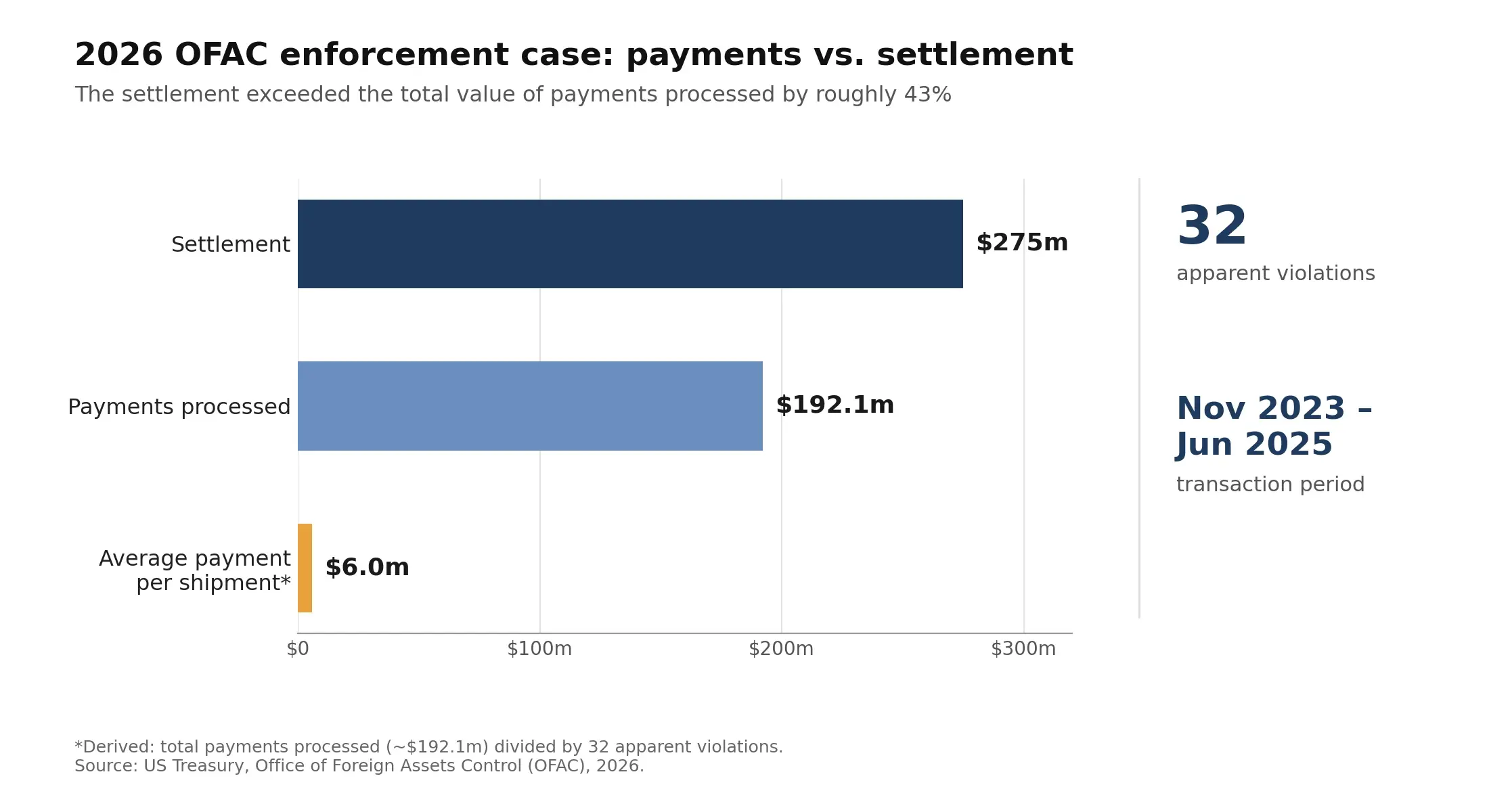
- In May 2026, OFAC announced a $275 million settlement with Adani Enterprises relating to 32 apparent violations of Iran sanctions. According to OFAC, between November 2023 and June 2025, Adani purchased LPG shipments from a Dubai-based trader that purported to supply Omani and Iraqi gas, while OFAC determined that red flags indicated the LPG actually originated in Iran.
See it on your own transactions
Screening, examination, and decisioning with AI — inside your trade workflow, with the reasoning attached.