Perfect Documents Hide Perfect Crimes: The TBML Paradox
SS
Satkrit Singh
18 September 2026 · 4 mins
Introduction & The Scale Of Global Trade
In 2025, world trade in goods and commercial services reached US$34.89 trillion, an 8% increase from the previous year, according to the WTO. At the same time, the global trade finance gap remains around US$2.5 trillion, according to the Asian Development Bank's latest survey.
Trade-Based Money Laundering (TBML) remains one of the most difficult financial crimes to detect because it operates in plain sight. Unlike cash smuggling or shell-company wire transfers, TBML uses physical goods as the vehicle for illicit capital. The core problem is simple but devastating: a transaction can pass a basic documentary check while still being commercially suspicious.
Emerging TBML Typologies: How Trade Value Gets Manipulated
Over-Invoicing Of Goods And Services
Over-invoicing involves deliberately declaring goods or services at an inflated value to facilitate the movement of illicit funds through legitimate trade.
In a FATF-documented case, in June 2006 a U.S. remittance operator colluded with a Pakistani exporter to over-invoice surgical goods, enabling additional funds to move through the transaction while the exporter also benefited from a 20% VAT rebate based on the inflated export value.
The case demonstrates why invoice validation alone may not identify TBML: the risk becomes visible only when declared value, payment flows, counterparties and economic purpose are assessed together.
Under-Invoicing Of Trade And Services
Under-invoicing conceals value by declaring goods or services below their true commercial price, allowing the differential amount to be settled outside the visible trade-finance trail. FATF identifies it as a core TBML technique.
In June 2021, a Pakistan Customs investigation illustrates the scale: an importer allegedly submitted falsified invoices showing substantially lower values; the exporter confirmed the actual invoices, while authorities assessed Rs 186 million in evaded duties and taxes.
Phantom Shipments
Phantom shipments occur when trade documents indicate that goods have been sold and shipped even though no goods are actually moved.
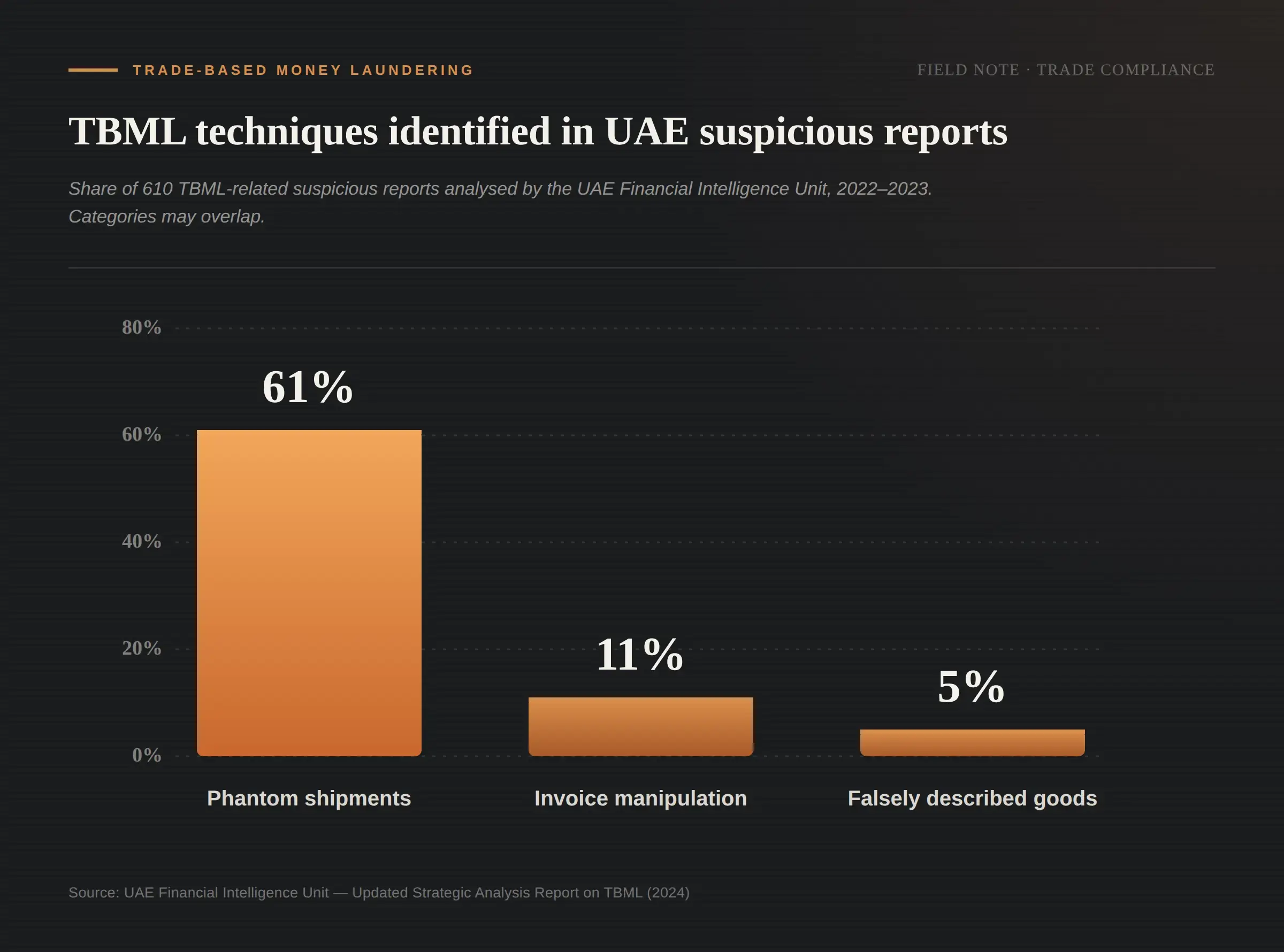
FATF identifies this as a TBML technique used to create a legitimate-looking basis for transferring illicit funds. The scale can be significant: a UAE FIU analysis of TBML-related suspicious reports found that were potentially linked to phantom shipments, making it the most frequently identified technique in the dataset.
Detecting such schemes therefore requires connecting trade documents with , rather than relying on document checks alone.
See it on your own transactions
Screening, examination, and decisioning with AI — inside your trade workflow, with the reasoning attached.
vessel movements, ports, shipment quantities, counterparties and payment data
Misdescription (Falsely Described Goods)
Misdescription occurs when the type, quality, or nature of goods or services declared in trade documents is deliberately misrepresented to disguise the true value or purpose of a transaction.
FATF identifies the misrepresentation of price, quantity or quality as a core TBML mechanism, while HMRC specifically notes that criminals may ship a relatively inexpensive commodity but falsely describe or invoice it as a higher-value product.
The scale is also measurable: an analysis by the UAE Financial Intelligence Unit in October 2025, covering TBML-related suspicious reports from 2022–2023, found that 5% involved falsely described goods.
For financial institutions, detecting misdescription requires comparing the declared goods with commodity characteristics, quantity, pricing, shipping documentation and the customer's normal trading activity, rather than relying solely on whether the documents appear complete.
The Cost Of Fragmented Controls: When Trade Risks Go Undetected
C'est Toi Jeans
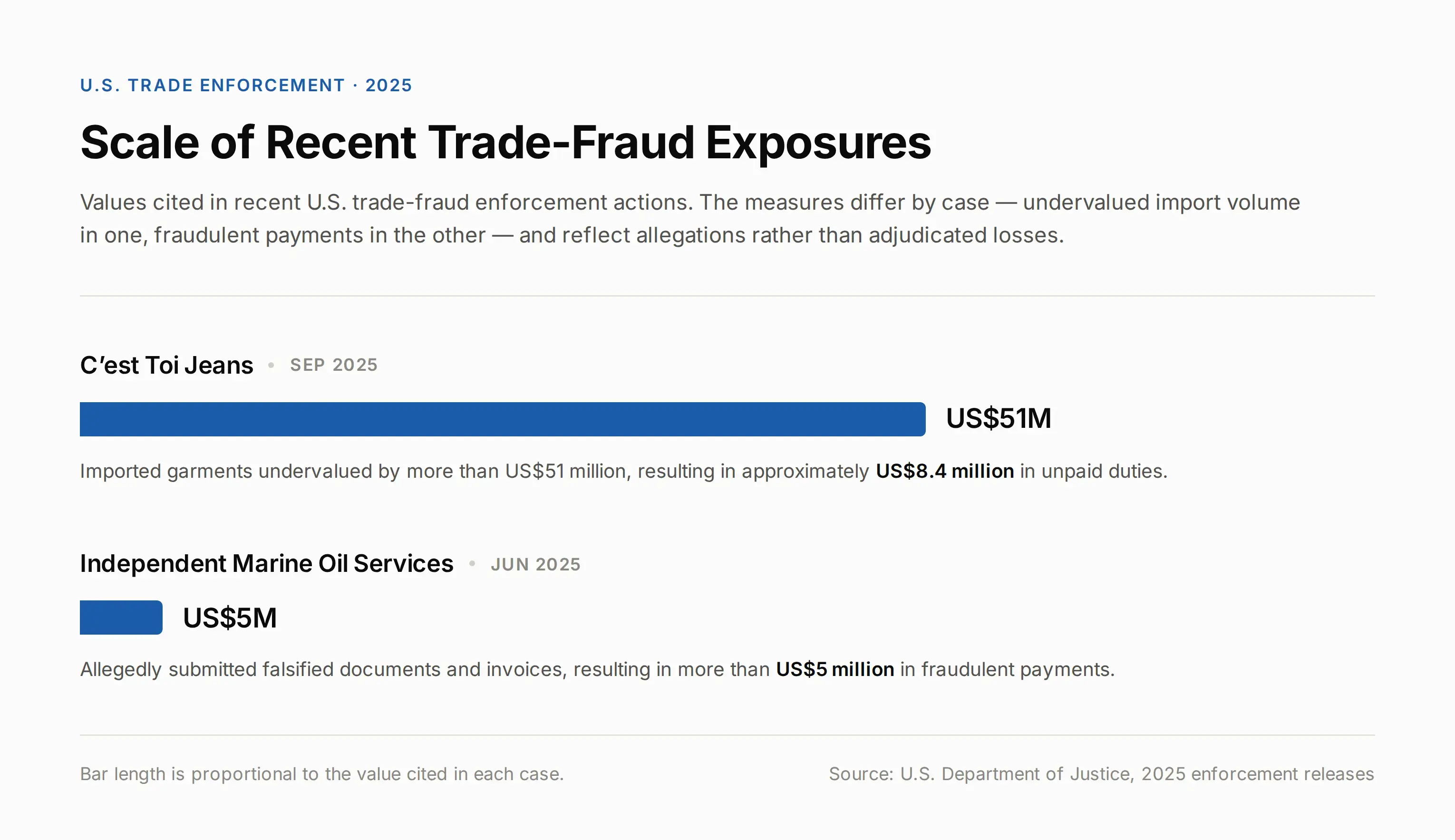
In September 2025, U.S. authorities sentenced executives of C'est Toi Jeans for a massive customs fraud and money laundering scheme. The company undervalued imported clothing by over US$51 million, evading US$8.4 million in duties. Investigators also identified 515 wire transfers totaling US$137.16 million to overseas suppliers.
Following a jury trial, the resulting penalties included:
C'est Toi Jeans: Five years of probation, federal monitoring, an $11.5 million fine, and over $15 million in restitution.
Si Oh Rhew (President): 103 months in prison, an $8 million fine, and over $19 million in restitution.
Lance Rhew (Corporate Officer): 84 months in prison, a $500,000 fine, and full restitution.
Independent Marine Oil Services
In June 2025, U.S. authorities indicted Jasen Butler, owner of Independent Marine Oil Services, for defrauding the U.S. military. He submitted altered and fabricated documents to U.S. Navy vessels, receiving more than US$5 million for expenses that had not actually been incurred. The falsified invoices falsely claimed fuel purchases at various international ports.
In January 2026, a federal jury convicted Butler of 34 felonies, including wire fraud, money laundering, and forgery.
Following his conviction, the resulting punishment included:
Jasen Butler (Owner): Sentenced in April 2026 to five years in federal prison for orchestrating the multi-million dollar fraud scheme.
Source: U.S. Department of Justice, 2025 enforcement releases.
From Red Flags To Transaction Intelligence: How AI Detects TBML
A. Detecting Price, Quantity and Quality Anomalies
AI can compare declared prices and quantities against historical transactions and market benchmarks. This is particularly relevant to over-invoicing, under-invoicing and misdescription, where individual documents may appear legitimate but the underlying economics are inconsistent.
FATF notes that advanced analytics and machine learning can support behavioural and transactional analysis, helping identify patterns that conventional rules may miss.
The scale of these techniques demonstrates why isolated document checks are insufficient. In the UAE FIU's analysis of TBML-related suspicious reports, phantom shipments appeared in 61% of reports, while invoice manipulation and falsely described goods accounted for 11% and 5%, respectively.These patterns require systems capable of connecting documents, commodity characteristics, pricing, shipment information and counterparties rather than examining each signal independently.
B. Connecting Documents With Physical Trade
AI can cross-reference:
Invoices
Bill Of Lading
Vessel Movements
Quantities
Payment Information
This is particularly important for phantom shipments, where trade documentation exists but the underlying movement of goods may not.
Rather than asking only whether documents are complete, transaction intelligence asks whether the documentary, physical and financial trails tell the same story.
C. Identifying Hidden Relationships
Graph analytics can map relationships between buyers, sellers, intermediaries, transactions, vessels and financial flows, helping uncover TBML networks that may remain hidden during individual entity screening.
Uncovering Transactional Patterns
ArgusTrade can connect trade data across counterparties, transactions, commodities and supporting documentation to identify recurring trading patterns, unusual transaction relationships and interconnected activity that may indicate layering, circular trade or coordinated TBML activity.
Following the Transaction Chain
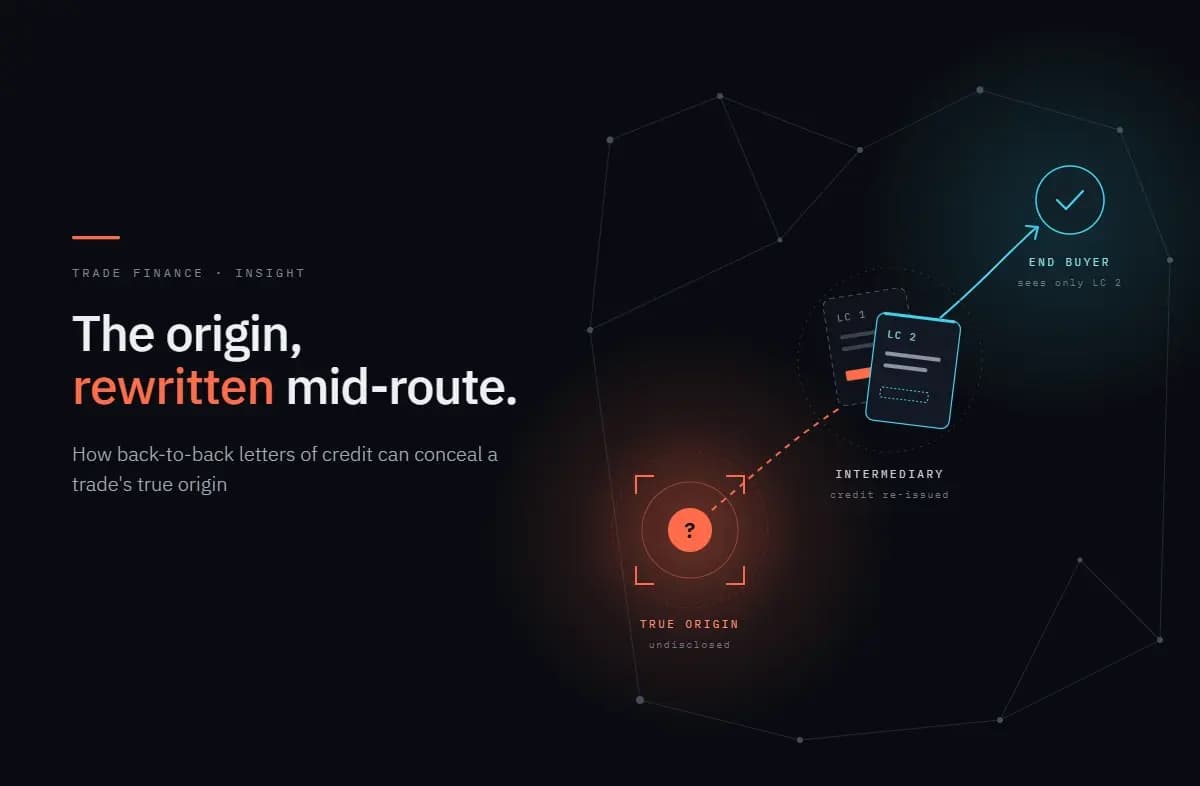
Linking trade documents with payment and counterparty data can reveal patterns such as circular trading, third-party payments and interconnected entities that appear legitimate when assessed separately.
This shifts TBML detection from:
“Is this entity risky?”
to:
“Does the wider transaction network indicate risk?”
D. From Individual Alerts To Transaction Risk
The ultimate shift is from rule-based alerts to combined risk assessment.
Traditional trade-finance controls often evaluate risk through isolated alerts, such as an unusual price, a documentation discrepancy or a high-risk counterparty. The greater risk emerges when these signals are connected.
A transaction showing an abnormal commodity price, inconsistent quantity, unusual routing and unexplained counterparty relationships should therefore be assessed as a single risk pattern rather than as separate alerts.
Price + quantity + quality: AI can compare declared values and quantities against historical transactions and market benchmarks to identify abnormal combinations.
Trade + financial trail: Linking invoices, shipping records, counterparties and payments can reveal whether the transaction's documentary, physical and financial elements are commercially consistent.
Conclusion
TBML prevention requires more than verifying whether individual trade documents are complete. The real risk lies in the relationship between goods, value, counterparties, logistics and payments.
Automation addresses this fragmentation by extracting and connecting data across the transaction, allowing AI to identify abnormal pricing, quantity or product descriptions, unusual trade routes and hidden relationships.
The key shift is from:
“Does this document comply?”
to:
“Does this transaction make economic sense?”
AI can continuously compare transactions against historical behaviour, market benchmarks and external intelligence, helping prioritise genuinely higher-risk cases for investigation.
Automation therefore does not replace human investigators; it augments them by detecting patterns at a scale and speed that manual review cannot achieve consistently. When combined with human oversight, it can make TBML controls more scalable, proactive and intelligence-driven, helping identify sophisticated trade manipulation before it becomes significant financial or regulatory exposure.
Beyond the Watchlist: Replacing Rigid Mandates with Pragmatic, Risk-Based Design
Introduction & The Macro Economic Paradox The global commerce landscape has undergone significant structural changes. Historically, economic sanctions…


 Source: U.S. Department of Justice, 2025 enforcement releases.
 The scale of these techniques demonstrates why isolated document checks are insufficient. In the UAE FIU's analysis of TBML-related suspicious reports, phantom shipments appeared in 61% of reports, while invoice manipulation and falsely described goods accounted for 11% and 5%, respectively.These patterns require systems capable of connecting documents, commodity characteristics, pricing, shipment information and counterparties rather than examining each signal independently.