Beyond the Watchlist: Replacing Rigid Mandates with Pragmatic, Risk-Based Design
Debanjan R Mukherjee
25 June 2026 · 4 Min
Introduction & The Macro Economic Paradox
The global commerce landscape has undergone significant structural changes. Historically, economic sanctions were used as blunt, secondary instruments alongside traditional military warfare to isolate certain geographical enemy governments. Between 1945 and 1990, the UN Security Council enacted just two comprehensive sanctions regimes. However, following the terrible humanitarian and economic consequences of the 1990s Iraqi embargo, a significant paradigm change occurred. Broad national bans have been essentially supplanted by hyper targeted, list-based regulations directed at specific individuals, business entities, shell companies, and boats.
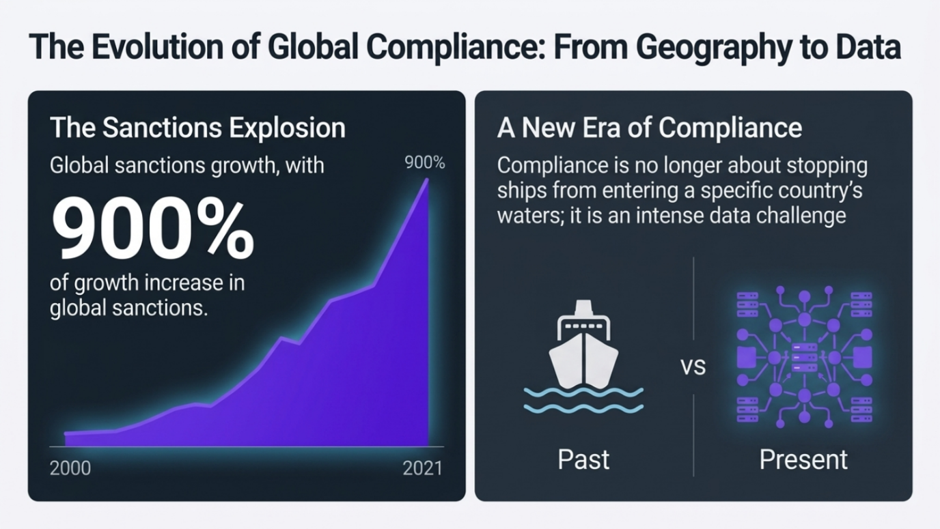
Today compliance is just not about going through list and cross validating it, it has become more pragmatic and have developed layers of supervision. The evolution of compliance from 2000 to 2021 which have shifted from embargo (complete ban on trade with a country) to multiple sanctions. Between 2000 and 2021, global sanctions deployment increased by a staggering 900%. Compliance is no longer about preventing ships from accessing a given country's waters; rather, it is a data intensive task. Regulators such as the US Office of Foreign Assets Control (OFAC) now maintain an active Specially Designated Nationals (SDN) list that includes well over 1700+ distinct entries from dozens of decentralised and dynamic regimes.
The Fallacy of Flat Watchlists & The Strict Liability Trap
Legacy trade compliance solutions rely on an inherently flawed paradigm the notion of "master list" aggregation. Many screening systems merely collect various government watchlists and store them in a flat digital database. However, as Peter L. Fitzgerald describes in his paper, worldwide watchlists are fundamentally inconsistent, unstandardised, and plagued by significant data ambiguity. A problem causing delays in operations is the issue with matching identities. Watchlists often do not have unique information resulting in too many false matches that stop legitimate trades from happening. For instance, vague or common names like adding "Global" to a list of sanctions, against Yugoslavia make compliance teams manually check thousands of harmless transactions. This data mess gets even worse with names written in scripts.
The name محمد can be written in ways like Muhammad or Mohammed and this lets targeted people avoid being caught by simple name checks. This makes it hard for compliance teams to do their job and for businesses to operate smoothly. The issue of identity matching needs to be fixed to prevent these problems. Watchlists need to be more accurate to avoid matches and ensure that legitimate trades can happen without delays.
See it on your own transactions
Screening, examination, and decisioning with AI — inside your trade workflow, with the reasoning attached.